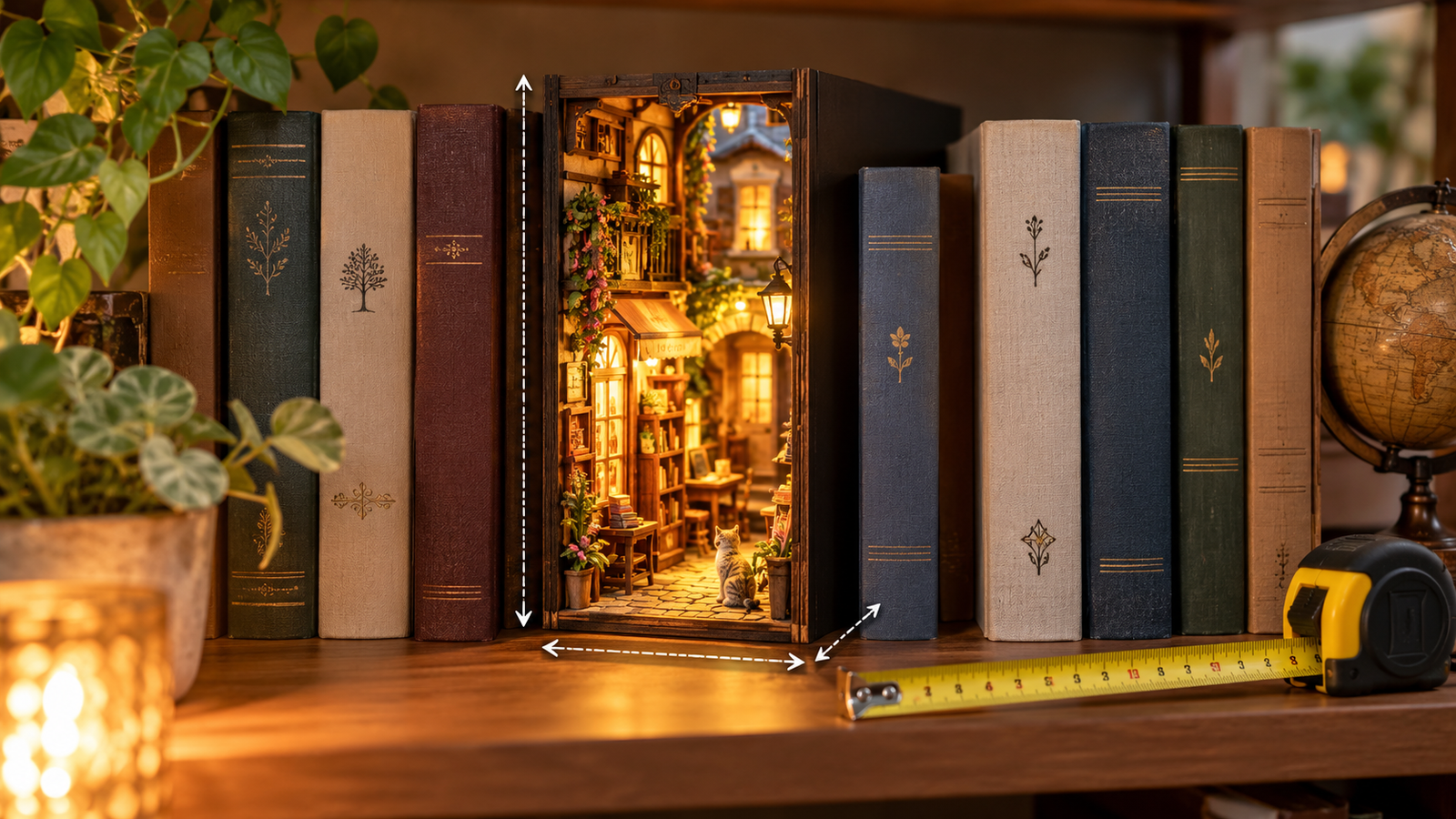
The magic is in the miniature. The challenge is finding space for it in the real world.
Imagine a little bookshop glowing between two novels. Beyond its doorway is a narrow lane, a staircase, perhaps a window with a light left on. From the front, a book nook can make a few inches of shelving feel like the entrance to another world. Whether it really belongs there depends on the shelf’s clear width, height and depth—and on the exact model’s finished dimensions.
But turn that tiny world sideways, and the illusion runs into something less magical: the shelf has edges. A decorative sign may stick out farther than the storefront. A roofline may meet the shelf above it. And the box that looked so compact in the shop might contain a model quite different in size once assembled.
Those three measurements sound straightforward. There’s more to the comparison than you might expect, though—even a manufacturer’s own listings can leave a little mystery.
The Hidden Footprint
Part of a book nook’s appeal is that it asks you to look into the shelf, not at the shelf. A narrow opening might frame a street, a library or an entire imaginary room. Your attention follows the scene inward; the wooden side panels and the space behind them are not the main attraction.
Those less glamorous parts still need somewhere to go. The front of a nook could look as slim as a book spine, while its scene extends farther toward the back of the bookcase. An ornamental roof, projecting sign or raised base can increase the space it occupies beyond the plain rectangular panels.
There’s a useful way to picture this: imagine an invisible box just large enough to contain every exterior part of the finished nook. That’s the space you’re comparing with the actual opening on your bookshelf. The decorations count, even when they’re the reason you fell for the scene in the first place.
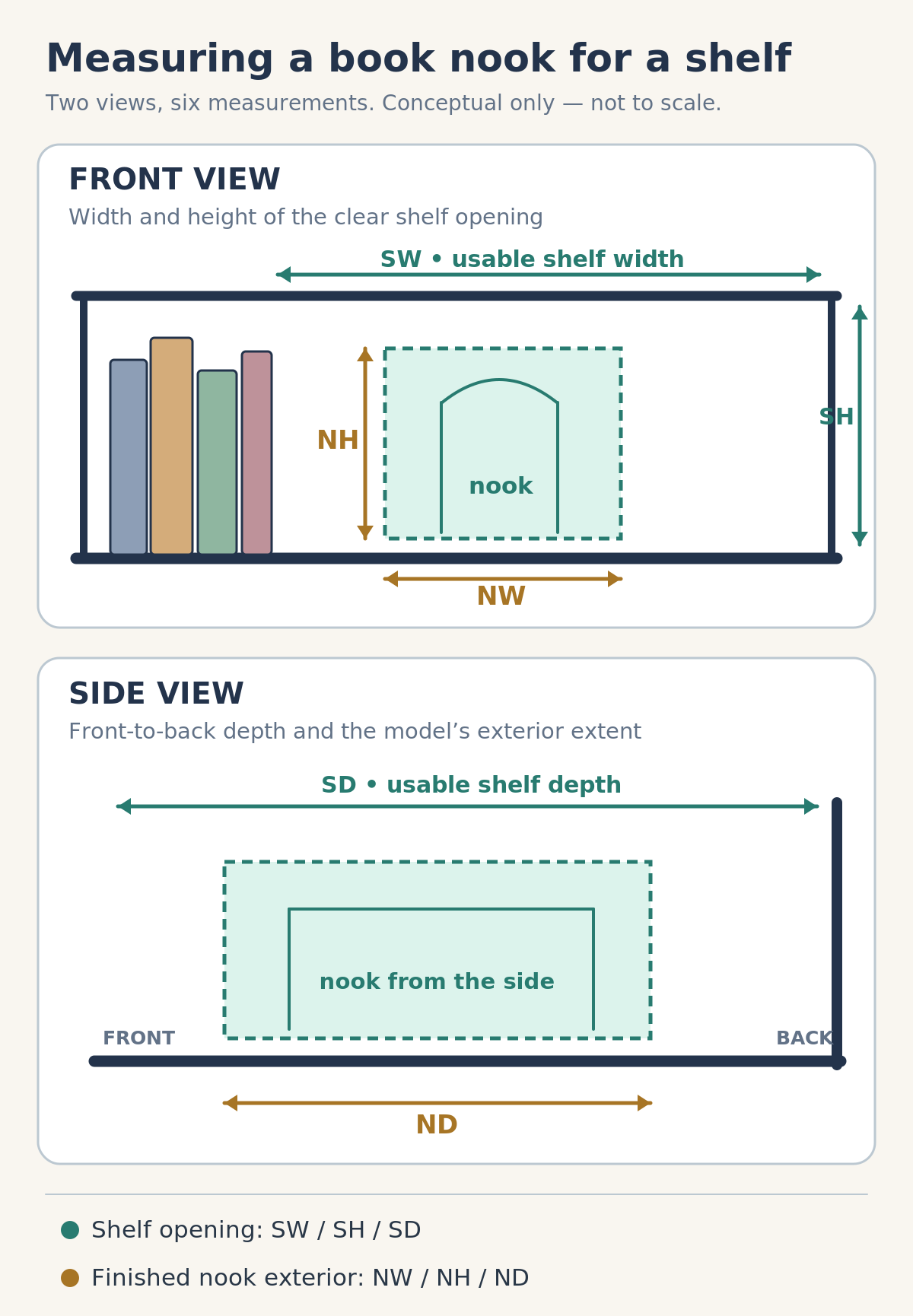
For the diagram and worksheet, the shelf measurements are SW (clear width between obstructions), SH (clear height above the shelf surface) and SD (usable front-to-back depth). The model measurements are NW, NH and ND: its greatest exterior width, height and depth in the intended display orientation. The trick is to compare like with like—not to swap dimensions around until the numbers look promising.
Width, Height, and Depth
The shelf is fairly straightforward. Width is the real opening available between books or side panels; height is the space below the next shelf or any bracket; depth is the surface available behind the front edge, taking account of a back panel or other obstruction. An advertised furniture size might not tell you any of those three things accurately for the spot you’ve chosen.

The book nook’s size is slightly trickier. Manufacturers may show a neat row of dimensions, but the order isn’t always explicitly labelled in the text. One listing may use length, width and height; another may use width, depth and height. An unlabelled number does not tell you which side of the miniature it measures.
Consider Rolife’s Bookstore TGB07. Its product listing gives an assembled-size sequence of 20 × 11.5 × 22 cm. That’s useful information, but the extracted listing text doesn’t establish the label for each axis. Before using it to decide whether the model fits a particular gap, you’d want a labelled manufacturer illustration or applicable instructions—not an educated guess about which number is the depth.
And there’s another distinction that’s easy to miss when browsing attractive product photos: package size is not assembled size. A flat box of wooden pieces tells you how the kit travels to your home, not how much shelf space the completed street or shop will occupy. It’s the miniature equivalent of measuring a tent by the bag it comes in.
The TGB01 Size Mystery
You might expect the manufacturer to settle any remaining uncertainty. Sometimes its own listings complicate the picture.
Take Rolife Sakura Densya TGB01. On October 30, 2026, two Rolife pages displayed different size sequences for the same named model:
| Rolife listing | Size shown | How the page describes it |
|---|---|---|
| Individual Sakura Densya TGB01 page | 190 × 115 × 220 mm | Assembled Size |
| Stories in Books four-kit bundle | 185 × 100 × 242 mm | Size |
Comparing the corresponding positions in the two published sequences, the numbers differ by 5 mm, 15 mm and 22 mm. We cannot establish from the listing text whether the pages are using precisely the same measurement convention or why the figures differ. It would be misleading to pick the more convenient sequence, average them or claim that the 22 mm difference definitely refers to height.
For someone with a roomy shelf, the discrepancy might not change the display decision. For someone trying to squeeze a miniature railway or shopfront into a precise gap, it could change the decision completely.
That is the unexpectedly interesting side of book nook dimensions: a beautifully imagined little place can come with a very ordinary product-data problem. When the space is tight and the listings disagree, the useful answer isn’t to invent a clever tolerance. It’s to check a labelled manual or diagram for the exact version, or ask the maker or seller to confirm the dimensions.
Shelf Fit and Clearance
Suppose the model’s exterior measurements are smaller than the opening in every direction. That sounds like the end of the story. It isn’t necessarily.
A book nook still has to get into its position. A roof detail might catch while you’re sliding it past the neighboring books, even if the model would sit comfortably once in place. A projecting lamp could be protected when stationary but awkward when you lift the scene out to dust the shelf. A model whose base appears to fit may still need a check that it is fully supported rather than hanging over an edge.
And some miniature worlds have unromantic maintenance needs. Depending on the model, a touch control or battery compartment may be on the front, side, top or rear. If the nook is pressed into a tight recess, reaching that control or changing the batteries could mean moving the whole scene. The exact locations depend on the kit, so the relevant manual matters more than a generic rule.
This is also why blanket advice such as “leave half an inch” is less useful than it sounds. A little extra room may help, but no single clearance guarantees insertion, access or safe removal across different designs. An elaborate shop sign and a plain-sided model may pose different problems even when their basic measurements look similar.
The same caution applies to familiar bookcases. Whether a nook fits in an IKEA BILLY, a KALLAX or an unnamed secondhand shelf depends on the actual opening you have, the installed shelf positions and the finished model—not just the name on the furniture.
Book Nook Fit Worksheet
The geometry itself is refreshingly simple. For each matching axis:
Space left over = usable shelf dimension − finished book nook dimension
A negative result rules out the recorded orientation at that opening. Zero leaves no nominal handling room. A positive result is encouraging, but it isn’t a guarantee that the model can be inserted or accessed.
Here’s a deliberately hypothetical example—not a measured shelf or a tested book nook:
| Direction | Clear shelf space | Imaginary nook’s exterior | Space left over |
|---|---|---|---|
| Width | 150 mm | 115 mm | 35 mm |
| Height | 260 mm | 220 mm | 40 mm |
| Depth | 240 mm | 200 mm | 40 mm |
The numbers work as arithmetic. They don’t prove that 35–40 mm is the right handling margin for any real kit. That’s where protrusions, controls and the way you place the nook enter the picture.
If curiosity has turned into a purchase plan, this small worksheet is enough to take the idea from “that would look good on my shelf” to a decision grounded in the measurements you actually have:
Your measurement worksheet
| Direction | My usable shelf opening | Finished nook exterior | Difference | Model + source URL + date checked | Anything in the way? |
|---|---|---|---|---|---|
| Width | ______ | ______ | ______ | ______ | ______ |
| Height | ______ | ______ | ______ | ______ | ______ |
| Depth | ______ | ______ | ______ | ______ | ______ |
Use one unit throughout; 1 inch = exactly 25.4 mm. If the maker hasn’t clearly identified the axes, or two official listings disagree, write “verify” instead of filling the blank with a guess. If a model dimension exceeds the corresponding shelf opening, the recorded orientation does not fit that opening. If all three are smaller, the remaining question is whether you can place, support and access the finished scene without catching any delicate details.
A Place on the Shelf
Book nooks are appealing partly because they turn everyday furniture into something less ordinary. A row of books becomes the wall around a miniature street; a small opening can suggest a room beyond the page. It’s easy to enjoy that idea without ever buying a kit.
But if you do want to bring one home, the measurements deserve a little of the same attention as the scene. Check the clear opening, find the exact model’s assembled dimensions, and make sure the labels and access points actually match your plan. When the specifications conflict, let the uncertainty stay visible until it’s resolved.
A miniature world doesn’t need much space. It does need the right space—and that is part of the charm of finding a home for it.